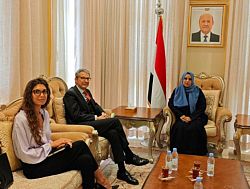
Minister of State Discusses Building Yemeni Women’s capacities with Italian Ambassador
The Minister of State for Women’s Affairs, Dr. Ahd Jaasous discussed Saturday with the Italian Ambassador to Yemen Carlo Baldocci ways to strengthen joint cooperation in the areas of women’s economic empowerment and capacity building.
Arab League Calls for Confronting Rising Anti-Muslim Hate
The Arab League on Sunday called for intensified international efforts to confront the growing phenomenon of hate speech and discrimination against Muslims in order to prevent deeper divisions among religions and cultures.

Oil price tops $100 a barrel
Oil prices jumped above $100 per barrel today, Monday, as the U.S. Navy prepares to take control of ship movements in the Strait of Hormuz.

Inter Milan a win away from Serie A title
Inter Milan continued its successful march to reclaim the Italian football league title, despite drawing with its host Torino (2-2), in the conclusion of the 34th round of the competition.
Last Update: ،
2026/05/02
Time
09:27:29
Latest News:
 Yemeni Coast Guard Locates Oil Tanker Hijacked off Shabwa Coast
Minister of Human Rights Reviews Conditions of Inmates at Aden Central Prison
Al-Arada Confers with British Ambassador over Assisting Government's Reforms Program
Al-Barakani celebrates EU Ambassador's tour in Taiz, highly appreciates EU interventions
Minister of Education Discusses Partnership with "Pure Hands"
Latest News:
Yemeni Coast Guard Locates Oil Tanker Hijacked off Shabwa Coast
Minister of Human Rights Reviews Conditions of Inmates at Aden Central Prison
Al-Arada Confers with British Ambassador over Assisting Government's Reforms Program
Al-Barakani celebrates EU Ambassador's tour in Taiz, highly appreciates EU interventions
Minister of Education Discusses Partnership with "Pure Hands"
Houthi-Saleh coup caused deterioration of situation in Yemen, official affirms
[22/08/2017 03:15]

NEWYORK-SABA
Yemen Local Administration Minister has affirmed that the situation in Yemen deteriorated due to the military coup carried out by the Houthi-Saleh militias against the legitimate government led by President Abdu Rabbu Mansour Hadi.
He affirmed, in a speech delivered in a symposium arranged by Yemen and Saudi Arabia missions to the United Nations in New York, that the solid diagnosis of Yemen's crisis is a key to a comprehensive resolution.
In the symposium entitled "partners for the sake of permanent peace in Yemen", Fatah spelt out that the militias staged a war against references of the National Dialogue Conference, refused the GCC-brokered initiative and the UNSC resolutions on Yemen, causing the deteriorated humanitarian situation.
He explained that 20.000.000 Yemenis need humanitarian assistances, 10.300.000 Yemenis are in an urgent need to assistances, 14.400.000 persons lack drinking water and sanitation, 14.100.000 lack food, 14.800.000 persons need essential health care, 4.500.000 persons suffer from malnutrition, 1.700.000 children and women suffer from cute malnutrition, 11.300.000 IDPs need protection, 4.5 IDPs lack shelters, 463.275 are infected with watery diarrhea (cholera), 3.400.000 pupils could not join schools, and 10,811 civilians were killed and 64,850 others were wounded.
He hailed efforts exerted by the UN organizations in Yemen, affirming that they work in the fields of relief and control of cholera, emphasizing that these organizations receive all support and facilities from the Yemeni government and Yemen's Higher Committee for Relief.
The minister noted that the legitimate government demands donors and organizations to provide relief and assistances, but some assistances are still distributed by the militias, stressing the importance of distribution relief and assistances from governorates and ports run by the government, not from ports run by the militias.
Fatah mentioned that the Arab Coalition's countries led by Saudi Arabia and the United Arab Emirates provided relief aids through the King Salman Center for Relief and Humanitarian Aids, the UAE Red Crescent, the Kuwaiti Relief Committee to all governorates without any conditions.
He explained that the King Salman Center for Relief and Humanitarian Aids could provide food assistances and medicines for Taiz and Sa'ada, and that the UAE Red Crescent and the Kuwaiti Relief Committee covered most Yemeni governorates.
The minister affirmed that the Higher Committee for Relief had suggested the application of decentralization in the relief work through dividing Yemen into five relief centers.
Yemen Local Administration Minister has affirmed that the situation in Yemen deteriorated due to the military coup carried out by the Houthi-Saleh militias against the legitimate government led by President Abdu Rabbu Mansour Hadi.
He affirmed, in a speech delivered in a symposium arranged by Yemen and Saudi Arabia missions to the United Nations in New York, that the solid diagnosis of Yemen's crisis is a key to a comprehensive resolution.
In the symposium entitled "partners for the sake of permanent peace in Yemen", Fatah spelt out that the militias staged a war against references of the National Dialogue Conference, refused the GCC-brokered initiative and the UNSC resolutions on Yemen, causing the deteriorated humanitarian situation.
He explained that 20.000.000 Yemenis need humanitarian assistances, 10.300.000 Yemenis are in an urgent need to assistances, 14.400.000 persons lack drinking water and sanitation, 14.100.000 lack food, 14.800.000 persons need essential health care, 4.500.000 persons suffer from malnutrition, 1.700.000 children and women suffer from cute malnutrition, 11.300.000 IDPs need protection, 4.5 IDPs lack shelters, 463.275 are infected with watery diarrhea (cholera), 3.400.000 pupils could not join schools, and 10,811 civilians were killed and 64,850 others were wounded.
He hailed efforts exerted by the UN organizations in Yemen, affirming that they work in the fields of relief and control of cholera, emphasizing that these organizations receive all support and facilities from the Yemeni government and Yemen's Higher Committee for Relief.
The minister noted that the legitimate government demands donors and organizations to provide relief and assistances, but some assistances are still distributed by the militias, stressing the importance of distribution relief and assistances from governorates and ports run by the government, not from ports run by the militias.
Fatah mentioned that the Arab Coalition's countries led by Saudi Arabia and the United Arab Emirates provided relief aids through the King Salman Center for Relief and Humanitarian Aids, the UAE Red Crescent, the Kuwaiti Relief Committee to all governorates without any conditions.
He explained that the King Salman Center for Relief and Humanitarian Aids could provide food assistances and medicines for Taiz and Sa'ada, and that the UAE Red Crescent and the Kuwaiti Relief Committee covered most Yemeni governorates.
The minister affirmed that the Higher Committee for Relief had suggested the application of decentralization in the relief work through dividing Yemen into five relief centers.
Key words:
decentralization - Administration - comprehensive - SABA Yemen - organizations - Humanitarian - malnutrition - distribution - governorates - deteriorated -
Yemeni Coast Guard Locates Oil Tanker Hijacked off Shabwa Coast
Minister of Human Rights Reviews Conditions of Inmates at Aden Central Prison
Al-Barakani celebrates EU Ambassador's tour in Taiz, highly appreciates EU interventions
EU Ambassador: Taiz Stands Out for Diversity, Earns EU Backing for Recovery and Development
Premier and Foreign Minister Praises Saudi Arabia’s Fraternal Role in Supporting Yemen and Its People
Yemen: Houthi Attacks in Bab al-Mandab Part of Iran’s Maritime Strategy
Planning Minister meets with German Ambassador
Minister of Public Works Discusses with UNOPS Ways to Enhance Support for Road Projects
Transport Minister Discusses with U.S. based Valar Company Mechanisms to Develop Aviation Security, Qualify National Cader
Al-Subaihi Stresses Importance of Enhancing Performance of Ministry of Youth and Sports