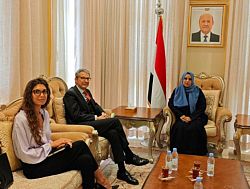
Minister of State Discusses Building Yemeni Women’s capacities with Italian Ambassador
The Minister of State for Women’s Affairs, Dr. Ahd Jaasous discussed Saturday with the Italian Ambassador to Yemen Carlo Baldocci ways to strengthen joint cooperation in the areas of women’s economic empowerment and capacity building.
Arab League Calls for Confronting Rising Anti-Muslim Hate
The Arab League on Sunday called for intensified international efforts to confront the growing phenomenon of hate speech and discrimination against Muslims in order to prevent deeper divisions among religions and cultures.

Oil price tops $100 a barrel
Oil prices jumped above $100 per barrel today, Monday, as the U.S. Navy prepares to take control of ship movements in the Strait of Hormuz.

Inter Milan a win away from Serie A title
Inter Milan continued its successful march to reclaim the Italian football league title, despite drawing with its host Torino (2-2), in the conclusion of the 34th round of the competition.
Last Update: ،
2026/05/02
Time
07:49:00
Latest News:
 Yemeni Coast Guard Locates Oil Tanker Hijacked off Shabwa Coast
Minister of Human Rights Reviews Conditions of Inmates at Aden Central Prison
Al-Arada Confers with British Ambassador over Assisting Government's Reforms Program
Al-Barakani celebrates EU Ambassador's tour in Taiz, highly appreciates EU interventions
Minister of Education Discusses Partnership with "Pure Hands"
Latest News:
Yemeni Coast Guard Locates Oil Tanker Hijacked off Shabwa Coast
Minister of Human Rights Reviews Conditions of Inmates at Aden Central Prison
Al-Arada Confers with British Ambassador over Assisting Government's Reforms Program
Al-Barakani celebrates EU Ambassador's tour in Taiz, highly appreciates EU interventions
Minister of Education Discusses Partnership with "Pure Hands"
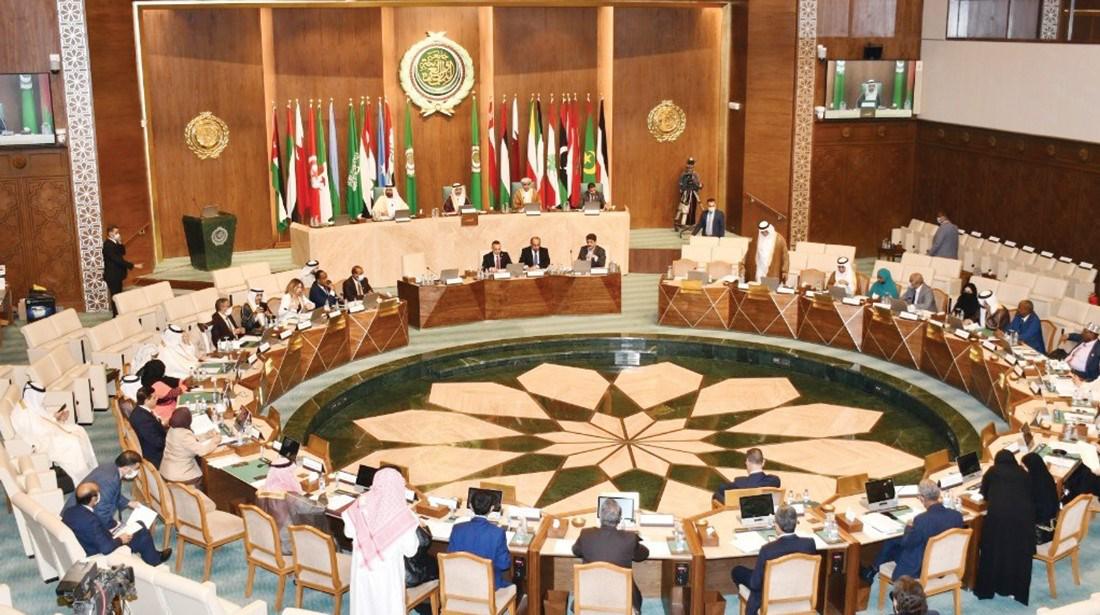
Arab Parliament renews full support for Yemen and its legit institutions under the Presidential Council
[10/06/2023 03:15]
Cairo - Saba
The Arab Parliament renewed its full support for the Republic of Yemen and its legitimate institutions under the leadership of the Presidential Leadership Council headed by President Dr. Rashad Muhammad Al-Alimi and members of the Council, in accordance with the agreed terms of reference, in order to restore the state and end all the consequences of the coup carried out by the Houthi militia.
In its statement issued today, the Arab Parliament affirmed its full support for establishing peace and reaching a comprehensive and genuine political settlement in accordance with the three references agreed upon nationally, regionally and internationally, and in accordance with what guarantees the right of the Yemeni people to a decent life, saves the blood, dignity and property of its people, and safeguards public freedoms and human rights.
The Arab Parliament appreciated all Arab and international efforts, as well as the efforts of the Special Envoy of the Secretary-General of the United Nations to Yemen, Hans Grundberg, to end the crisis and implementing UN resolutions. It stressed the need for the UN envoy and the United Nations to assume their full responsibilities in stopping the obstinacy of the Houthi militia and its increasing futility.
The Arab Parliament renewed its full support for the Republic of Yemen and its legitimate institutions under the leadership of the Presidential Leadership Council headed by President Dr. Rashad Muhammad Al-Alimi and members of the Council, in accordance with the agreed terms of reference, in order to restore the state and end all the consequences of the coup carried out by the Houthi militia.
In its statement issued today, the Arab Parliament affirmed its full support for establishing peace and reaching a comprehensive and genuine political settlement in accordance with the three references agreed upon nationally, regionally and internationally, and in accordance with what guarantees the right of the Yemeni people to a decent life, saves the blood, dignity and property of its people, and safeguards public freedoms and human rights.
The Arab Parliament appreciated all Arab and international efforts, as well as the efforts of the Special Envoy of the Secretary-General of the United Nations to Yemen, Hans Grundberg, to end the crisis and implementing UN resolutions. It stressed the need for the UN envoy and the United Nations to assume their full responsibilities in stopping the obstinacy of the Houthi militia and its increasing futility.
Key words:
responsibilities - internationally - international - comprehensive - institutions - implementing - consequences - Presidential - establishing - appreciated -
Yemeni Coast Guard Locates Oil Tanker Hijacked off Shabwa Coast
Minister of Human Rights Reviews Conditions of Inmates at Aden Central Prison
Al-Barakani celebrates EU Ambassador's tour in Taiz, highly appreciates EU interventions
EU Ambassador: Taiz Stands Out for Diversity, Earns EU Backing for Recovery and Development
Premier and Foreign Minister Praises Saudi Arabia’s Fraternal Role in Supporting Yemen and Its People
Yemen: Houthi Attacks in Bab al-Mandab Part of Iran’s Maritime Strategy
Planning Minister meets with German Ambassador
Minister of Public Works Discusses with UNOPS Ways to Enhance Support for Road Projects
Transport Minister Discusses with U.S. based Valar Company Mechanisms to Develop Aviation Security, Qualify National Cader
Al-Subaihi Stresses Importance of Enhancing Performance of Ministry of Youth and Sports