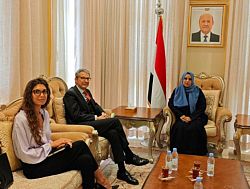
Minister of State Discusses Building Yemeni Women’s capacities with Italian Ambassador
The Minister of State for Women’s Affairs, Dr. Ahd Jaasous discussed Saturday with the Italian Ambassador to Yemen Carlo Baldocci ways to strengthen joint cooperation in the areas of women’s economic empowerment and capacity building.

Arab League Calls for Confronting Rising Anti-Muslim Hate
The Arab League on Sunday called for intensified international efforts to confront the growing phenomenon of hate speech and discrimination against Muslims in order to prevent deeper divisions among religions and cultures.

Oil price tops $100 a barrel
Oil prices jumped above $100 per barrel today, Monday, as the U.S. Navy prepares to take control of ship movements in the Strait of Hormuz.

Inter Milan a win away from Serie A title
Inter Milan continued its successful march to reclaim the Italian football league title, despite drawing with its host Torino (2-2), in the conclusion of the 34th round of the competition.
Last Update: ،
2026/05/02
Time
07:51:21
Latest News:
 Yemeni Coast Guard Locates Oil Tanker Hijacked off Shabwa Coast
Minister of Human Rights Reviews Conditions of Inmates at Aden Central Prison
Al-Arada Confers with British Ambassador over Assisting Government's Reforms Program
Al-Barakani celebrates EU Ambassador's tour in Taiz, highly appreciates EU interventions
Minister of Education Discusses Partnership with "Pure Hands"
Latest News:
Yemeni Coast Guard Locates Oil Tanker Hijacked off Shabwa Coast
Minister of Human Rights Reviews Conditions of Inmates at Aden Central Prison
Al-Arada Confers with British Ambassador over Assisting Government's Reforms Program
Al-Barakani celebrates EU Ambassador's tour in Taiz, highly appreciates EU interventions
Minister of Education Discusses Partnership with "Pure Hands"
CBY Deputy Governor discusses economic, financial developments with Chinese diplomat
[21/11/2024 03:34]
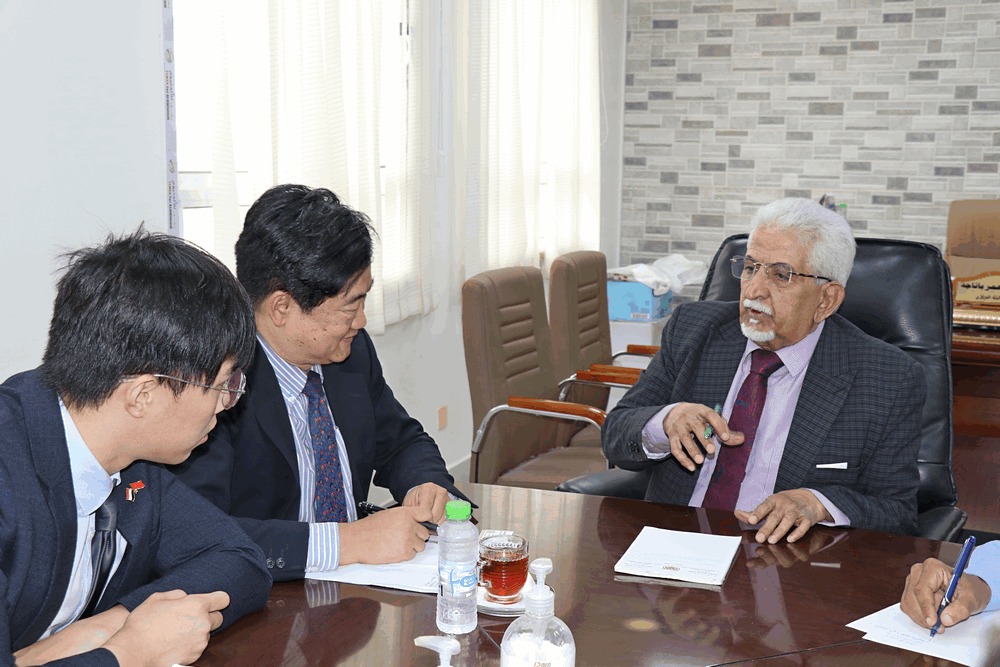
ADEN - SABA
Deputy Governor of the Central Bank of Yemen (CBY) Dr. Mohammed Omar Banajah discussed Thursday with Charge d'Affaires of Chinese embassy in Yemen Zhao Cheng latest developments in the economic and financial situation.
The two parties also discussed ways to enhance cooperation between Yemen and China.
During the meeting, the Deputy Governor reviewed the financial situation and the reasons for the sharp fluctuations in exchange rates, which are a direct result of the deteriorating economic conditions in the country due to the Houthi militia's attacks on oil export facilities.
This has led to a halt in oil exports, which are the main source of foreign currency funding for the state's treasury and has caused a doubling of the budget deficit and the balance of payments, he said.
He emphasized that the bank's management is working diligently to overcome these challenges by utilizing available monetary policy tools.
For his part, the Charge d'Affaires of the Chinese Embassy reaffirmed his country's commitment to restoring peace and stability in Yemen.
The Chinese government exert efforts to provide support to the Yemeni government in various fields, including the banking sector, to contribute to the implementation of reforms and the efforts being made by the Central Bank, he said.
Key words:
implementation - deteriorating - fluctuations - SABA Deputy - developments - cooperation - d'Affaires - challenges - During - diligently -
Minister of State Discusses Building Yemeni Women’s capacities with Italian Ambassador
Yemeni Coast Guard Locates Oil Tanker Hijacked off Shabwa Coast
Minister of Human Rights Reviews Conditions of Inmates at Aden Central Prison
Al-Arada Confers with British Ambassador over Assisting Government's Reforms Program
Al-Barakani celebrates EU Ambassador's tour in Taiz, highly appreciates EU interventions
Minister of Education Discusses Partnership with "Pure Hands"
Young Man Seriously Wounded by Houthi Sniper North of Taiz
Al-Subaihi: We need to step up efforts to promote transport businesses
EU Ambassador: Taiz Stands Out for Diversity, Earns EU Backing for Recovery and Development
Central Bank Board Reviews Economic Developments, Policy Responses