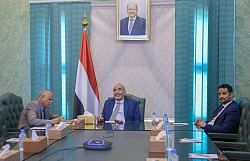
PLC Mahmoud al-Subaihi Meets US Ambassador on Ending Tenure
Member of the Presidential Leadership Council, Lieutenant General Mahmoud al-Subaihi, met today via video conference with the United States Ambassador to Yemen, Stephen Fagin, on the occasion of the conclusion of his diplomatic mission.

Magnitude 5 Earthquake Strikes Fiji Islands in the South Pacific
A magnitude 5.0 earthquake struck south of the Fiji Islands in the South Pacific Ocean on Sunday, according to the United States Geological Survey (USGS). The earthquake occurred at a depth of approximately 486.2 kilometers beneath the Earth's surface.

Oil price tops $100 a barrel
Oil prices jumped above $100 per barrel today, Monday, as the U.S. Navy prepares to take control of ship movements in the Strait of Hormuz.

Paris Saint-Germain Crowned UEFA Champions League Winners
French club Paris Saint-Germain claimed the UEFA Champions League title after defeating Arsenal 4-3 in a penalty shootout following a 1-1 draw in the final held at Puskás Aréna in the Hungarian capital, Budapest.
Last Update: ،
2026/06/09
Time
07:15:16
Latest News:
 President al-Alimi: Peace in Yemen Begins with Ending the Iranian Regime’s Agenda, Restoring National ..
Planning Minister, French Ambassador Discuss Development and Economic Cooperation
Prime Minister Receives Message from Chinese President to PLC Chairman on 70th Anniversary of Bilateral ..
Prime Minister Receives Indian Ambassador, Stresses Need to Convene Joint Committee
PLC Member al-Muharrami Receives UN Envoy, Discusses Developments and Peace Efforts in Yemen
Latest News:
President al-Alimi: Peace in Yemen Begins with Ending the Iranian Regime’s Agenda, Restoring National ..
Planning Minister, French Ambassador Discuss Development and Economic Cooperation
Prime Minister Receives Message from Chinese President to PLC Chairman on 70th Anniversary of Bilateral ..
Prime Minister Receives Indian Ambassador, Stresses Need to Convene Joint Committee
PLC Member al-Muharrami Receives UN Envoy, Discusses Developments and Peace Efforts in Yemen
President al-Alimi: Peace in Yemen Begins with Ending the Iranian Regime’s Agenda, Restoring National State Institutions
[09/06/2026 05:59]
RIYADH – SABA
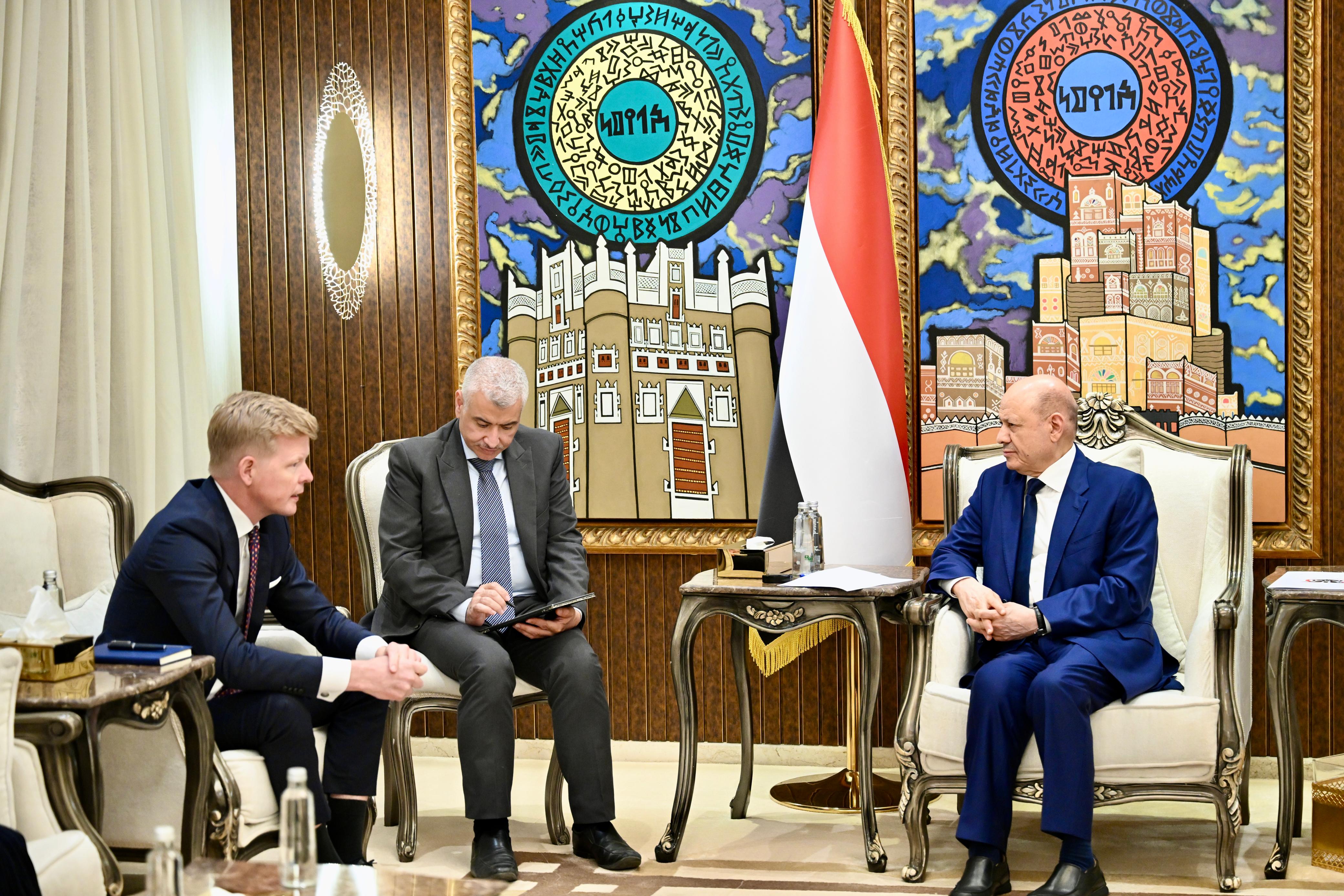
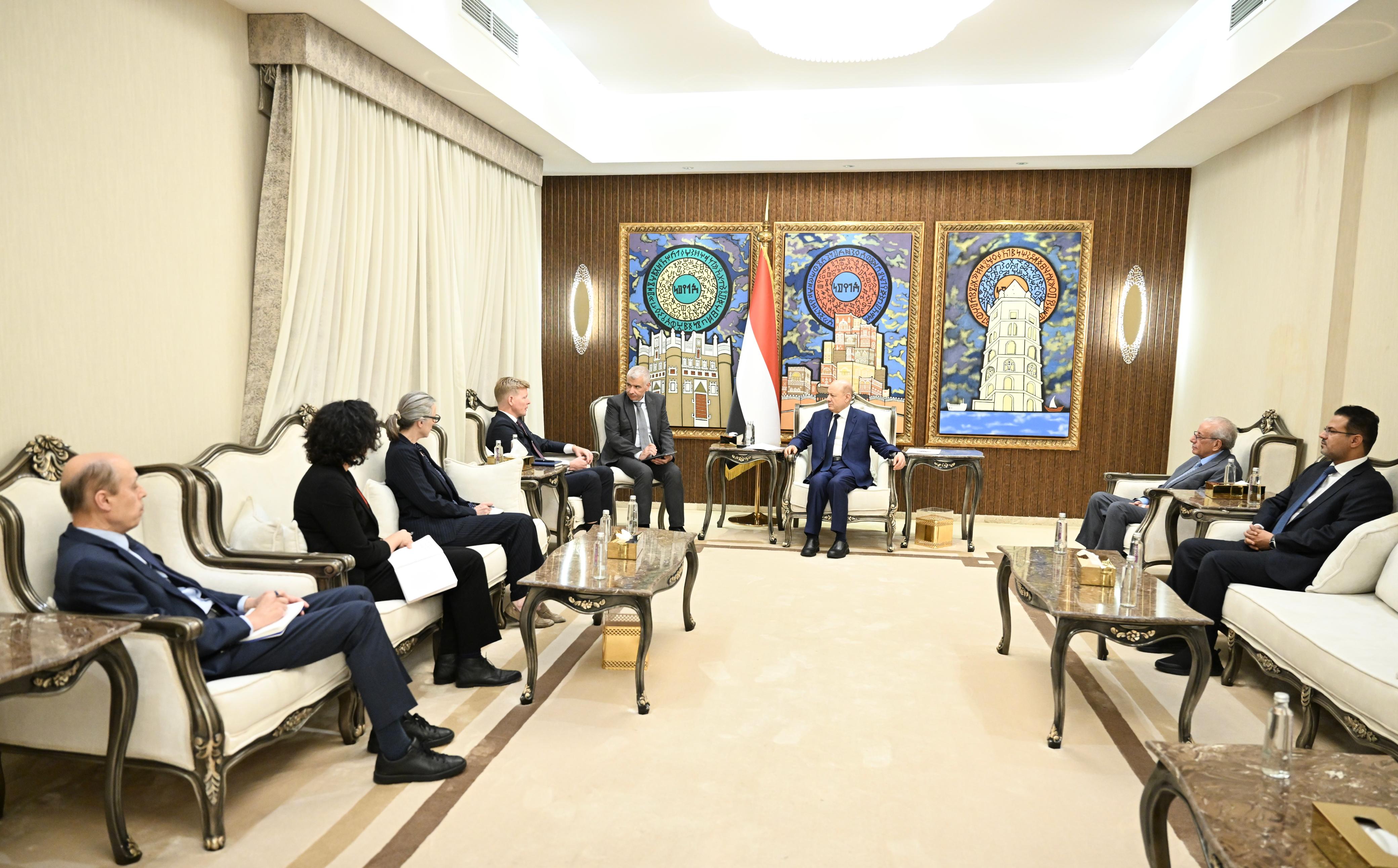
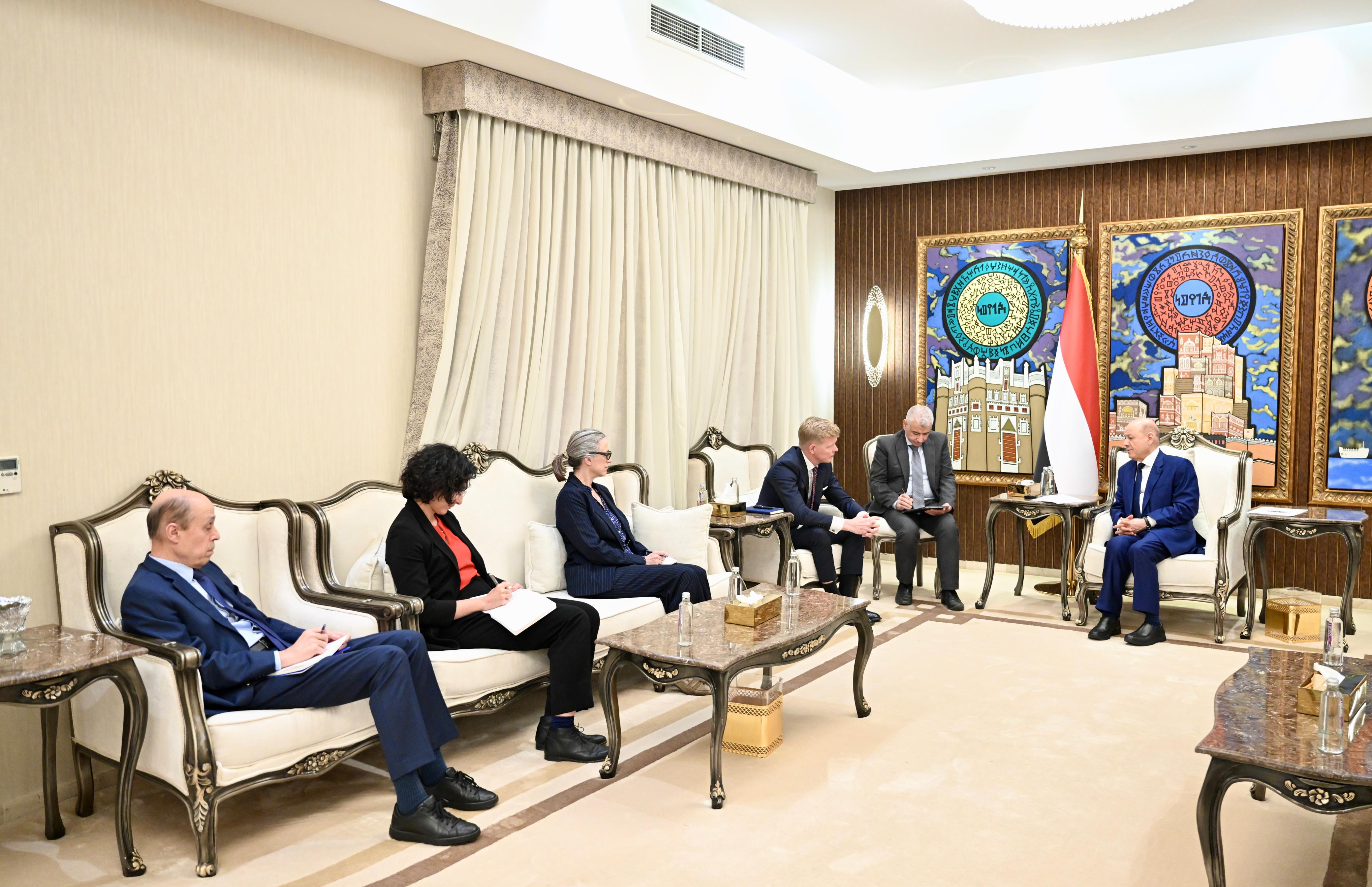
His Excellency President Dr. Rashad al-Alimi, the Chairman of the Presidential Leadership Council, received Tuesday the United Nations Special Envoy to Yemen, Hans Grundberg.
At the beginning of the meeting, the UN envoy extended his sincere condolences to the Chairman of the Presidential Leadership Council on the passing of Yemen’s prominent leader, former President Abd Rabbu Mansour Hadi and expressed his wishes for security, stability, and peace for Yemen and its people.
The Chairman of the Presidential Leadership Council was briefed by the UN envoy on the outcomes of his recent consultations, particularly regarding efforts to complete the implementation of the recently reached agreement for the release of 1,750 detainees.
He was also updated on the envoy’s coordinated efforts with the international community to revive the peace process in accordance with its established references, which the Iran-backed Houthi terrorist militias had overturned.
President al-Alimi reiterated his appreciation for the efforts of the UN envoy’s office and all regional and international partners—especially the Kingdom of Saudi Arabia, the Sultanate of Oman, and the International Committee of the Red Cross—in securing the detainee release agreement.
He described the agreement as an important humanitarian step that restores hope to thousands of Yemeni families and expressed his hope that this achievement would be built upon, without allowing any obstacles or delays by the militias to undermine its humanitarian purpose.
The President also addressed recent developments in the region, particularly the Houthi militias’ declaration of their involvement in defending the Iranian regime and its affiliated militias across the region.
He said this confirms their subordination to Tehran’s destabilizing project, including the use of Yemen as a platform to serve suspicious agendas unrelated to the interests of the Yemeni people.
The President stressed the importance of the international community recognizing that the crisis in Yemen is not merely a dispute between political parties, but rather a confrontation with an armed group that challenges the state's exclusive authority and is linked to a cross-border regional project directed by an operations room affiliated with Iran’s Islamic Revolutionary Guard Corps (IRGC).
President al-Alimi reaffirmed the commitment of the Presidential Leadership Council and the government to a path of sustainable peace based on the agreed references, particularly UN Security Council Resolution 2216, which addresses the root causes of the conflict rather than offering a temporary truce that could reproduce the conflict in a more complex form.
He emphasized that sustainable peace cannot be achieved through power-sharing between the state and a militia, but rather through restoring national institutions to their exclusive authority, upholding the rule of law, achieving justice and respecting rights and freedoms.
The President explained that while the Iranian regime speaks of de-escalation, its militias in Yemen continue campaigns of arbitrary detention, enforced disappearance, recruitment, and violations of public freedoms.
He also noted their continued involvement in assassinations, the elimination of opponents, confiscation of property, and suppression of civil society.
He stressed that these violations must remain a central component of United Nations reports, as they constitute some of the most significant obstacles to peace in Yemen and the wider region.
President al-Alimi also discussed domestic developments and the government's efforts to normalize conditions, address current challenges, and advance a comprehensive program of financial, administrative and institutional reforms.
He expressed his aspiration for a more active role by the United Nations in mobilizing international support for the reform program, safeguarding the fundamental references for a comprehensive settlement, and preventing any humanitarian understandings from being transformed into political or military gains. He also stressed the need to address the growing interconnection between the Yemeni issue and regional developments as a key factor in any future approach to peace.
President al-Alimi warned that every day the restoration of state institutions is delayed increases the risk of Yemen becoming a permanent platform for regional conflicts and a threat to international navigation and collective security.
He emphasized that this requires greater clarity in defining the problem, stronger action in addressing its root causes, and sustained support for the Yemeni state as the sole guarantor of security and stability.
Key words:
partners—especially - interconnection - understandings - assassinations - administrative - implementation - confrontation - international - institutional - comprehensive -
President al-Alimi: Peace in Yemen Begins with Ending the Iranian Regime’s Agenda, Restoring National State Institutions
President al-Alimi Chairs Cabinet Meeting to Support Recovery Efforts, Regular Salary Payments
Al-Alimi Receives Further Condolences on the Passing of Former President Hadi
UAE Leadership Extends Condolences to Leadership Council Chairman on Passing of Former President
President al-Alimi leads funeral procession of former President Abd-Rabu Mansour Hadi
President al-Alimi Congratulates Kings, Emirs, Presidents of Arab Countries on Eid al-Adha
President al-Alimi Congratulates Eritrea on Independence Anniversary
President al-Alimi: Unity has been Nobel Humanitarian, National Project for Southern, Northern Generations
President Reaffirms State Commitment to Fully Resolving Detainees File
President al-Alimi Appreciates Japanese Support for Comprehensive Recovery Efforts In Yemen